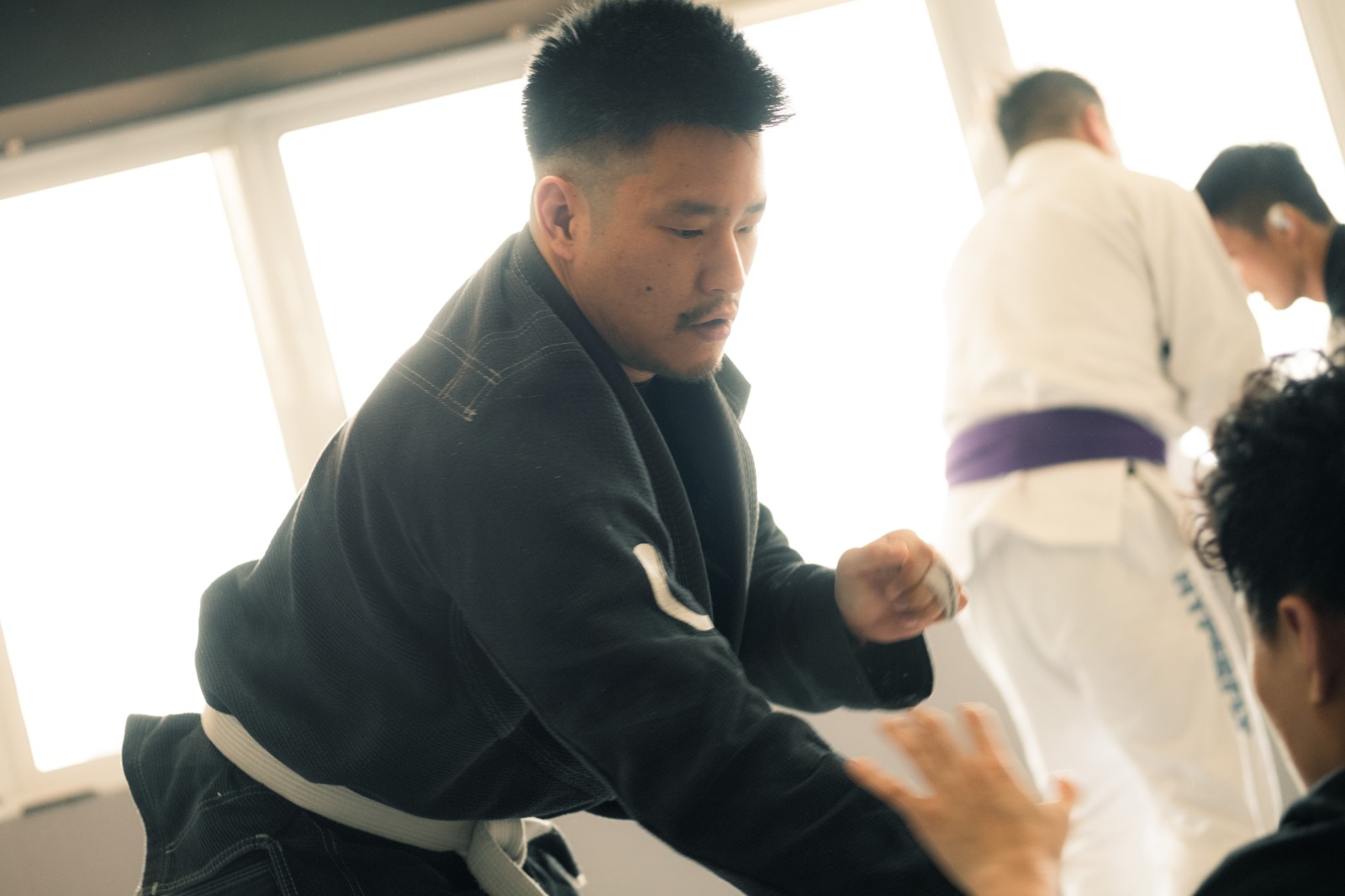

Jiujitsu is often translated from Japanese as “the gentle art”, but the day-to-day reality doesn’t feel gentle at all. It feels more like a fight for your life, with bigger, stronger, faster opponents trying their damndest to twist your limbs in directions they aren’t supposed to go, or wrap their arms or even clothes tightly around your neck and cut off your air supply or the flow of blood to your neck until you are incapacitated. You spend hours trapped under your opponent with the wind being driven from your lungs, fighting desperately to survive, while another human drips sweat into your eyes while wrenching your body in contortions that leave you feeling like you’ve been hit by a truck. And I love it.
I’ve been practicing jiujitsu, Brazilian Jiu Jitsu more specifically, for around 5 and a half years. I’m not good by any means, I’m not gifted athletically, I’m stiff and slow, and I care more about my safety than “winning”. But I’ve improved by miles, and now finally feel comfortable handling most people who haven’t trained before, even if they are big, fast, and strong. There’s nothing easy about this sport. A famous jiujitsu saying is “there can only be one person comfortable at a time, and you want to make sure you’re that person”. I train at least 4 days a week, and after every session, no matter how tough it is, feel better for having gone through it. I have learned a lot from BJJ, and I’m sure I’ll write a lot more about it. But right now, as I go through a tough period in my life, I’d like to share specifically how training has made the rest of my life easier.
A Jiujitsu training session is almost always the most difficult thing I’ll do that day
Jiujitsu training is tough, not only do you need to use the mental focus and physical exertion to execute the moves, but when you are live sparring there is also an opponent whose sole focus is to stop you from doing what you want to do. There’s hardly any other moment in your average day when another person’s goal is the exact opposite of yours, but we do it to ourselves, and each other each time we train. Even on a day of difficult work, unpleasant chores or errands, or other challenges, jiujitsu will be the hardest thing I do that day, and knowing that makes everything else easier. This was especially true when I used to train first thing in the mornings, but even now that I usually train at night, the rest of my days are easier since I’m used to doing such a challenging activity day in and day out.
Being in the moment
I’ve never been able to meditate consistently, it’s something I’d like to work on, but I haven’t learned to just sit there and focus. But with jiujitsu, no matter what is going on in my life, in the middle of a hard roll, there are no other thoughts than the present. What my opponent is trying to do, what I need to do, where to put my body, concentrating on where their weight is, timing a critical moment where I can come up with an advantage. The outside world disappears, and all that matters is what’s right in front of me at that second. That is a great thing to have every day, at least 30 minutes to an hour of not thinking about work, life problems, or anything else, and it has definitely helped me be calmer off the mats.

Pushing through adversity on the mat is a transferrable skill
Jiujitsu forces you to learn to endure pressure and be calm under stressful situations. If you panic or overreact, you will just make your position worse and go through a snowball effect of suffering. This is true off the mat as well, remaining calm and collected makes everything easier and allows you to get through tough situations. It’s a natural reaction to react negatively to pressure or being uncomfortable, but when you practice jiujitsu you get exposure to it every day and it helps you deal with it better in other areas of life. When you are training jiujitsu, not only do you have to deal with the physical pressure and stress of someone fighting you, but you also have to overcome the mental challenges of not giving up, pushing your body to keep going when you are tired or in a tough spot, and the knowledge that every time you show up there will be someone better/faster/stronger than you that you will have to deal with. All of these add up to a lot of exposure to stress that makes daily problems like a flat tire or an incompetent co-worker much easier to deal with.
Overcoming pain and fear builds your tolerance to it
Some people say that in jiujitsu your white belt (the rank you start at) is the hardest one to earn, because most people never start training, even if they want to they are too afraid to start. Even for those who overcome that hurdle, many people quit after a short time because of how hard it is to get beat up by everyone at the gym who has been training longer and is better than you. Many people get nervous or anxious before a training session, I think it is because getting physically dominated by someone is a scary thing, and it hits your ego very hard. You have to learn how to push past that fear to continue training and get better. Ideally, you won’t be in physical pain to the point of injury during your training, but the reality is that jiujitsu is a combat sport and everyone I train with has dealt with injuries to some extent. Even when you are not injured, you still get put in painful positions, like when a heavier guy is putting all their weight on you while trying to strangle you or wrench your arm behind your back. The more I’ve trained the more I’ve been able to push past my limits and get over the fear of being crushed by someone better. This has translated to other areas of my life when I am afraid or anxious about doing something, but am able to push myself to just do it.

I’ve learned to measure progress in inches
On average it takes 10 years of training consistently to earn a black belt in BJJ, by some estimates that’s only 0.1% of the people who start training. It is a long and slow journey, as you get better your rate of improvement slows and you can’t see yourself getting better day by day or even month by month. The progress also isn’t linear, it is very common to hear people talk about how they feel they have plateaued for months before making a small leap in improvement. Once you learn the basic moves, refining them takes years, one small adjustment with a grip, a faster reaction time to someone you’ve seen your opponents do hundreds of times, or adding on a new step in a series of techniques are what it takes to get better. It is also even harder to see your improvement because the people you are training with are getting better too. All of this means you need to keep consistent and keep training even when you feel like you are stuck. I think this is a hugely important lesson in today’s world of instant gratification and “hacks” when we want to see results immediately with our attention spans and dopamine addled from social media and sound bites. It has been super helpful to remember that progress takes time in other areas of my life. I also have learned to like the fact that improvement is slow and hard because if it were easy, it wouldn’t mean as much.

I now value discipline over motivation
This one is taken from ex-Navy SEAL commander, BJJ black belt, and leadership coach Jocko Willink. But it has rung so true for me and helped me get off my ass and to the gym on many days. Often when we start a new hobby or even job, we are gung ho and super motivated, but after a while or when things get tough, that motivation evaporates, and if you don’t use discipline to keep going you will give up. So it is an important lesson to have the discipline to do the things you need to do, and not rely on motivation to keep you going. Of course, you should be balanced, get enough rest, and take care of your other responsibilities, but there will be plenty of days where staying home and watching Netflix sounds better than rolling around on the ground with a bunch of other sweaty people. And if you don’t enforce discipline on yourself to go and train, you won’t end up going and eventually quit. I’ve seen a lot of people start jiujitsu and be super into it for 5 or 6 months, and then after they realize that they aren’t going to become a world champion, they start coming less and less until eventually, they disappear. Using discipline instead of motivation has helped me in many areas of my life like diet, finances, work, and more.
I’m so grateful for starting jiujitsu and the lessons it has taught me, because those lessons have helped make other parts of my life easier in many ways. I hope to be practicing this art until I’m at least 60 and I’m sure it will continue to benefit the rest of my life the whole time. If you haven’t tried jiujitsu, I highly suggest you give it a shot and see how it helps your life in other ways!