Tag: personal essay

  • Waiting for the Wake-Up Call

    Waiting for the Wake-Up Call

    I had my first real health scare last year during my annual screening. My treadmill ECG test came back abnormal. I’ve always been pretty healthy, lucky enough not to have any chronic issues or frequent illnesses, so this was quite a shock. After booking a follow-up with a cardiologist, it started playing with my mind. While hitting pads at a normal Muay Thai session, I started to feel tightness in my chest. My heart, which was beating fast already from the exercise, started beating even faster, flailing around inside my chest, telling me I should stop.  

    I kept thinking about what I could have done differently to not end up there: fewer burgers, fewer beers, more exercise… or maybe less exercise? I didn’t know, I was confused and frankly, scared. I started thinking about my daughter and what if she lost me early, or if I would ever be able to meet my grandkids. I kept the worries to myself, but they were eating at me from inside.

    After a full panel of tests, including a CT scan, it turns out the ECG reading was a false positive. There’s nothing wrong with my heart, and I don’t have to worry about suddenly keeling over. Before the results came back, I told myself I would feel amazing if I got cleared. I wanted to be one of those people with a new lease on life, a second chance I was going to make the most of, never take a single day for granted again. But that didn’t happen. I was relieved I didn’t have to quit sports, and that I’m not in imminent danger of a heart attack at any moment. But that sense of drive or renewed purpose never came. 

    Then I remembered my parents’ wake-up call. I was 16 when 9/11 happened. My childhood was in a pretty normal suburban American neighborhood outside of Seattle. But after the attack, something woke up in my parents; they decided or realized they weren’t happy living in the “city” and wanted to be in a smaller town, closer to nature. Within three months, they had moved five hours’ drive from Seattle, across the mountains, just outside a tiny town with only one stoplight. I went from a high school of 1500 to a town of the same size. 

    Logically, I understand how a tragedy like that can make people realize life could end at any time and push them to rethink how they want to live. But they never seemed unhappy before, so the decision to move to the middle of nowhere always felt like it came out of thin air. 

    My not feeling strongly could mean I’m doing enough to live the life I want, so no regrets or big changes needed. On the other hand, what if I’m just not self-aware or reflective enough to know I want something different in life until I’m much older and it’s too late to do anything about it? In most ways, I’m a pretty easy-going person. I don’t have huge ambitions to take over the world or anything. But I also am particular about my likes and dislikes and how I spend my time. Which is why I thought getting my heart cleared would push me to use my time more intentionally. But nothing feels like it’s changed. I don’t know what that means yet, or if it will hit me later. But I keep wondering if I should feel more than I did. riate comment, how am I going to teach her enough? Because I believe I am strong and confident. And yet, in both situations, even where there was no physical danger, I stayed quiet.

  • Who Gets The Best Of Us

    Who Gets The Best Of Us

    Recently, my family told me they feel like I treat other people better than I do them. My first reaction was defensive. Of course, I act “nicer” around colleagues or strangers. With family, I don’t need to self-censor or perform. And honestly, it doesn’t feel unusual; most people probably do this to some extent. But once I sat with it, I started wondering whether that’s actually true for everyone, and if it is, why we so often fail to show up as our best selves at home.

    At home, I notice my irritation bubbling up over small things, like having to repeat myself or when my wife doesn’t know something I think she should. The kind of thing I would never let show if a colleague did it. I’d smile, let it go, and find a tactful way around it. But at home, my tone becomes sharp, the annoyance shows on my face, and it hurts the people I want to hurt the least. It’s not planned or conscious, and I always regret it, but it still happens.

    Closeness makes it easy to say things we would never say to anyone else. Maybe I hurt the people closest to me because I don’t have my public face on, and my words come out rougher than they need to. Maybe it’s just volume. More time together means more chances to irritate each other. But that doesn’t feel like the whole story. It feels like something gets used up out there, being who I think I need to be in the outside world, and by the time I’m with my family, I don’t want to have to be careful anymore.

    Reading some of Erving Goffman’s work helped me make sense of that. He wrote about how much of social life is performance, how we’re constantly adjusting ourselves to fit the situation we’re in. Seen that way, it isn’t surprising that we’re more careful, measured, and restrained in public than we are at home. That level of attention takes energy, even if we don’t notice it in the moment. And when that energy runs out, our ability to stay patient and measured goes with it. What’s left shows up most clearly at home, in shorter patience, sharper words, and a lower tolerance for the people who are closest to us.

    The irony is hard to ignore. We give our best selves to people who matter less in the long run, and the people who matter most get whatever’s left over. That feels backwards. But swinging too far in the other direction, treating colleagues or strangers worse just to preserve more energy for family, doesn’t feel right either. I’m still trying to understand what it means to give the people closest to me more than whatever happens to be left, and whether there’s a reasonable balance between letting my inner asshole out and putting on an act at home. Finding it, and keeping it, doesn’t seem easy.

  • The Parts I Left Out

    The Parts I Left Out

    I used to hate answering the question “Where are you from?”. It sounds simple, but it never was for me.

    The answer is, “I’m from Seattle.” But that always led to follow-up questions. As an Asian in the US, people asked about my ethnicity or where my parents were from. In China and Singapore, people assumed I was an American-born Chinese. So I’d end up explaining that I was adopted by caucasian parents when I was 4 months old, but was actually born in Korea. Then the usual questions: “No, I don’t speak Korean.” “No, I haven’t found my birth parents.” “Yes, I call my adoptive parents mom and dad.”

    For a long time, I kept these conversations short. It wasn’t that I was ashamed of who I am; it’s just complicated, and it was easier to downplay or simplify things. Over the past year, though, I’ve started to embrace my identity instead of minimizing it. I’ve been surprised how much it has helped me grow and connect with people. I’ve realized that the surprising things about my background are part of what I’m made from. And sharing more openly doesn’t complicate things; it helps people understand more of who I am.

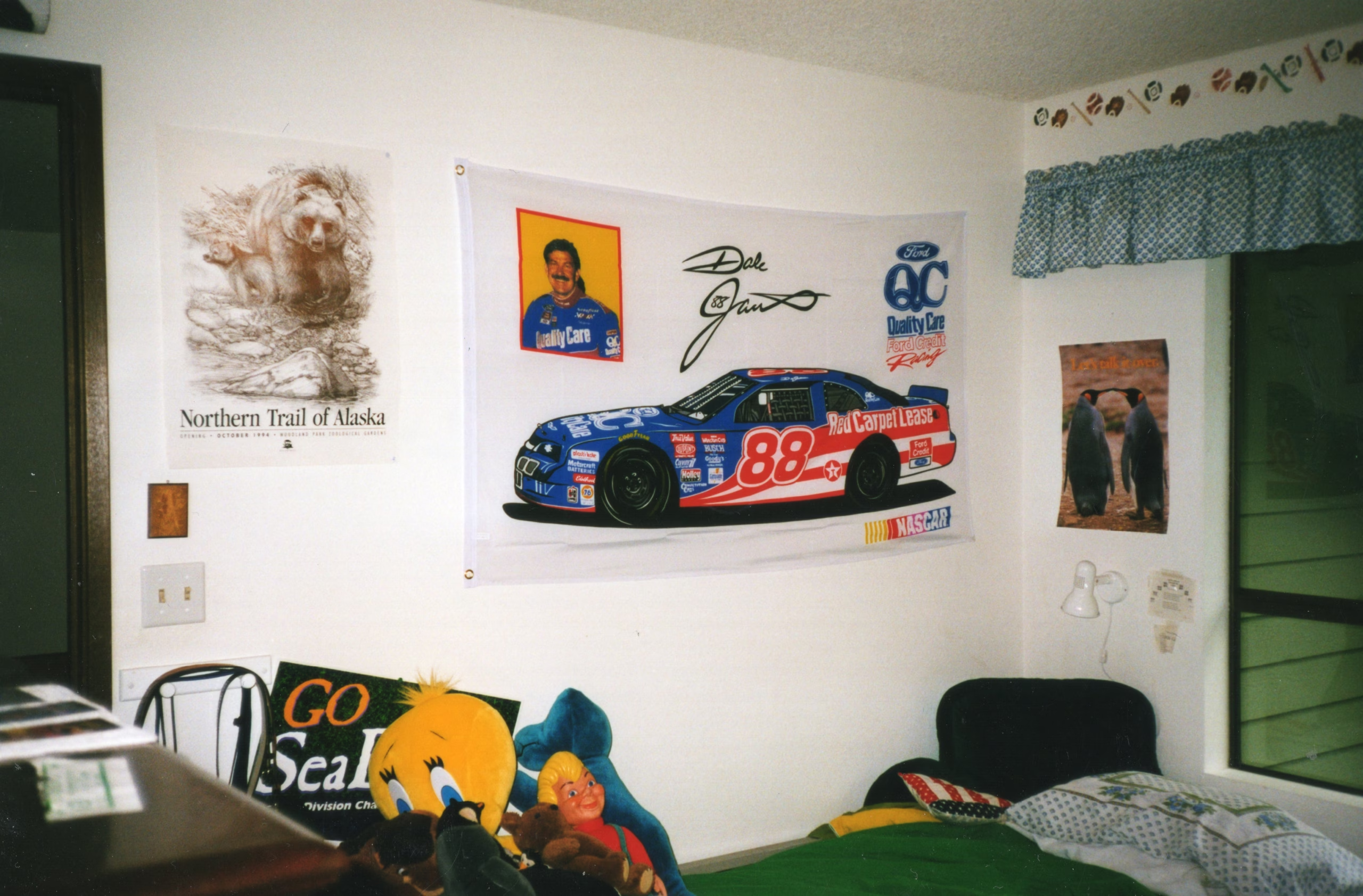
    And there are surprising things about me that people wouldn’t expect by looking at me. I grew up as suburban Americana as it gets: bologna sandwiches and RC cola, tuna casseroles and minivans. I was a die-hard NASCAR fan and never missed a race from around ’93 to after Dale Earnhardt died. I threw thousands of pitches against a board in the backyard, listening to Dave Niehaus call Mariners games on the radio. I had a mullet for most of my teen years, and my first concert was Tim McGraw and Faith Hill. But that didn’t seem easy to share, even with friends I’d had for years. I didn’t think much about it for years, but at some point, I realized this wasn’t just my experience; most people do some version of the same thing. We share a simpler, safer version of ourselves with the world in an effort to protect ourselves.

    When I stopped editing my story down to the safest version and started sharing more, interesting things started happening. People opened up to me, too. Someone I knew was also adopted. Someone else had lost a parent. Another person felt conflicted about their heritage. These conversations built deeper relationships. It wasn’t that I was turning every conversation into an autobiography or listing my quirks as an ice-breaker. I was just being more open about who I am, and people responded to it. I didn’t know it at the time, but minimizing my identity wasn’t just about avoiding awkward conversations; it kept people from really knowing me.

    I also realized that I’d pushed parts of my past so far down that they barely felt connected to me anymore. I’d kept my story neat and short for so long that I stopped thinking about the details myself. When I started being more open, those old influences and memories resurfaced, not in a nostalgic way, but in a clearer “this is part of me” way. My tastes, preferences, and daily habits have changed a lot over the years, but that doesn’t mean those earlier versions of me weren’t real or meaningful. Growth doesn’t require erasing the past; it just requires putting it in context.

    A lot has changed since those mullet-and-country-music years, but that’s still a part of who I am. Those things shaped me. These days I can’t tell you who won the last Daytona 500 anymore, but as new chapters of my life unfold, I’m learning not to shrink the story. The more I share, the more I connect. I’m still learning how to tell the fuller version of who I am, but it starts with not hiding the parts I used to leave out. For now, that feels like real progress.