Category: Marketing

  • What Teaching Marketing at NUS Reminded Me About Storytelling

    What Teaching Marketing at NUS Reminded Me About Storytelling

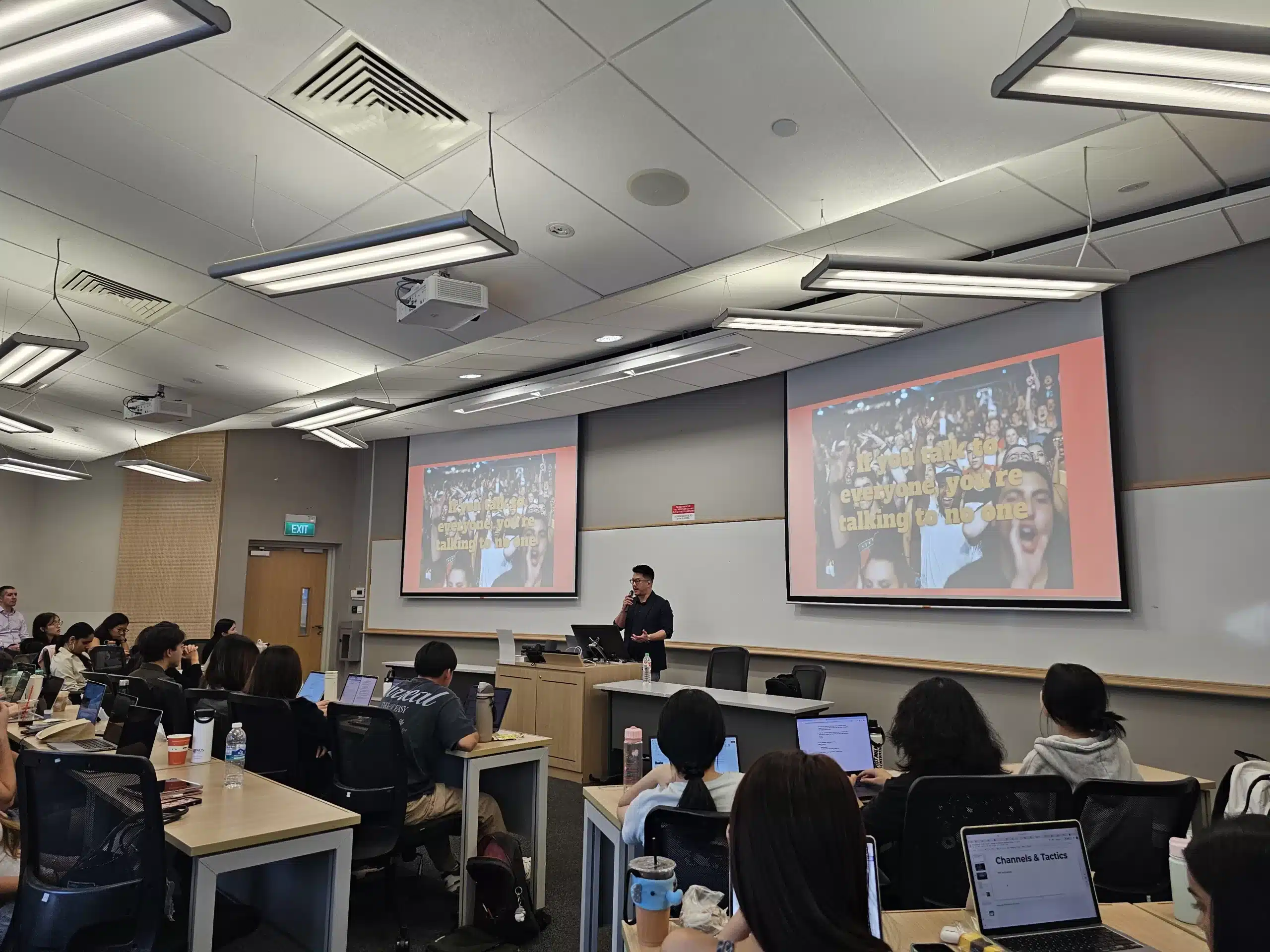
    Last week I gave a guest lecture to about fifty marketing undergraduates at the National University of Singapore. Standing in front of students just beginning their careers took me back to my own start – except I never studied marketing in school. I learned it by doing: launching campaigns with shoestring budgets, experimenting with untested channels, and learning from people who knew more than I did. Those lessons compounded over time through curiosity, observation, and plenty of trial and error.

    What struck me during the lecture is how much a marketing career still follows that same pattern. You’re always learning, adjusting, and adapting as you go.

    Theory Meets Reality

    The topic was “Choosing Marketing Channels and Tactics.” Simple in theory, messy in practice. Choosing the right mix isn’t about following a playbook, it’s about understanding your audience, clarifying your objectives, and making hard trade-offs with limited time and resources. A tactic that dominates in one market can die quietly in another. What looks brilliant in a deck doesn’t always survive contact with actual customers.

    I structured the lecture around three principles that have consistently guided my work:

    Adapt to local market needs. Every market is different. What resonates in Australia might fall flat in Japan. Across APAC, localization isn’t a buzzword – it’s survival.

    Fail fast. The sunk cost fallacy kills campaigns. Learning to stop, extract the lesson, and pivot quickly is one of the most valuable skills you can develop.

    You can’t do everything everywhere all at once. Focus wins. Prioritize the channels and tactics that actually drive results instead of diluting your impact across too many fronts.

    What Actually Connected

    To illustrate these principles, I shared real examples from my own campaigns: the wins and the embarrassing failures. This connected and showed how important stories are to getting your message across. The students asked great questions, they wanted to know how decisions were actually made under pressure, what went wrong, and what I’d do differently knowing what I know now.

    It reminded me how powerful stories are for making sense of complexity. Stories give structure to the chaos of real projects. They show what principles look like when applied under constraints, with incomplete information, and with real consequences. Even when you’re discussing data or tactics, stories make the information stick because they reveal the human side, the pressure, the uncertainty, the learning.

    Beyond the Classroom

    This applies far beyond teaching. In marketing itself, the campaigns that cut through are built around clear, human stories. Behind every effective message is a narrative: a problem worth solving, a change that needs explaining, a better way forward. Tools and metrics matter, but they’re scaffolding around the story, not the story itself.

    Great marketing doesn’t start with channels or tactics. It starts with understanding the story you’re trying to tell and who needs to hear it. Everything else flows from there.

    Looking Forward

    Leaving that classroom, I felt genuinely optimistic about the next generation. These students were engaged, skeptical in the right ways, and hungry to understand how the industry actually operates. If they hold onto that curiosity and keep building their own stories through experience, they’ll be more than ready for whatever marketing becomes next.

    The fundamentals don’t change: understand your audience, tell a clear story, adapt when reality pushes back, and never stop learning. Everything else is just choosing which tools to use.

  • Breaking Barriers and Building Bridges: 5 Lessons from a Trailblazing Career

    Breaking Barriers and Building Bridges: 5 Lessons from a Trailblazing Career

    Every conversation I host on the podcast teaches me something new, and my episode with a marketing agency leader was particularly enlightening. My guest shared insights on topics ranging from career development to overcoming challenges as a working parent, providing a lot of actionable advice along the way. Here are the top five lessons I took away from our conversation.

    1. Integration, Not Balance

    The term “work-life balance” has been around for decades, but my guest challenged its validity. For many of us, balance feels like an impossible goal—like trying to perfectly weigh a scale when life is inherently unpredictable. Instead, they offered a different perspective: integration.

    Integration means weaving work and life together in a way that makes sense for you and your priorities. It’s about accepting that you can’t have everything at the same time but can still create a fulfilling life through careful planning and intentional decisions. This approach also requires setting boundaries and communicating with the people around you about what matters most.

    For example, my guest shared how they’ve learned to advocate for support within their family. Whether it’s a partner, child, or extended family, open conversations about what you need to succeed can help create an environment where you’re not only supported but celebrated for pursuing your passions and ambitions.


    2. The Power of Communities

    Moving to a new city or starting over in a new environment can be daunting, but one of the ways my guest adapted was by finding and building communities. From professional networks to volunteer organizations, communities are a lifeline, especially during times of transition or uncertainty.

    Being part of these networks doesn’t just help you meet new people—it can give you access to diverse perspectives, shared experiences, and even opportunities you may not have known existed. My guest’s story reinforced that communities can be a source of resilience. They found that being surrounded by driven, supportive people helped them navigate challenges and feel less isolated.

    Interestingly, they emphasized how volunteering not only allows you to give back but can also be a personal growth tool. Volunteering in professional or high-stakes environments, like planning events or managing projects, builds transferable skills while also fostering connections.


    3. Networking is About Genuine Curiosity

    If you’ve ever dreaded walking into a networking event, you’re not alone—I know I’ve felt that way more times than I can count. My guest, who describes themselves as an introvert, had some fantastic advice for making networking less intimidating: approach it with curiosity.

    They highlighted the importance of asking thoughtful questions to shift the focus away from yourself. Networking becomes much easier when you’re genuinely interested in the person you’re speaking to, rather than worrying about impressing them. For example, instead of opening with generic small talk, ask about someone’s motivations or what excites them most about their work.

    This approach does more than ease the awkwardness; it creates meaningful conversations and connections. People appreciate being heard and valued, and by directing the focus to them, you often walk away with new insights or inspiration.


    4. Career Planning is Ongoing

    We often think of career planning as something we do early on—choosing a major in college or landing our first job—but my guest stressed that it’s an ongoing process. As we grow and change, so do our goals, and taking the time to reassess and recalibrate is essential.

    A particularly thought-provoking idea they shared was asking yourself the question: What do I want to retire as? For them, this exercise was about envisioning not just the title or role they wanted to hold but the legacy they wanted to leave behind.

    This long-term thinking helps clarify priorities and guide decisions. For instance, my guest realized they wanted to develop younger professionals, create award-winning campaigns, and work on a variety of projects before retiring. By identifying these aspirations, they were able to make strategic career moves to align with those goals.

    The lesson here is to continually check in with yourself. Are you on the path you want to be on? If not, what steps can you take now to move closer to where you want to go?


    5. Advocating for Yourself and Others

    One of the most powerful takeaways from our conversation was the importance of advocacy—both for yourself and for others. My guest shared examples of how they’ve had to speak up for their needs, whether in the workplace or at home, and encouraged others to do the same.

    This is especially important for working parents, and my guest provided valuable insights into the unique challenges faced by working moms. They emphasized the need for planning, support, and communication. For example, involving partners in childcare responsibilities and educating children about the value of their parents’ work can make a significant difference.

    But advocacy doesn’t stop at the individual level. My guest highlighted the need for systemic change in how workplaces view and support working parents, particularly mothers. While they expressed some pessimism about how much progress can be made in the short term, they remain committed to driving conversations and raising awareness.

    One poignant story they shared involved a leader who, while trying to be considerate, made a decision on behalf of a working mom without consulting her. It was a reminder of how important it is to give people the agency to make their own decisions and to ask what kind of support they need rather than assuming.


    Bringing It All Together

    These lessons resonated with me because they speak to universal themes: the importance of prioritizing what matters, building meaningful connections, and staying proactive in both personal and professional growth.

    What struck me most about this conversation was how these ideas intersect. Advocating for yourself requires clarity on your priorities, which can come from reflecting on your career goals or seeking advice from your community. Likewise, balancing—or integrating—your work and personal life often depends on having a strong support network and the courage to ask for help.

    Each of us has the power to implement these lessons in our own way. Whether it’s joining a community, rethinking your career trajectory, or simply starting a conversation at your next networking event, small steps can lead to meaningful change.

    Listen to the full episode here!

  • Top 5 Lessons from My Recent Podcast Guest on Entrepreneurship, Family, and Finding Balance

    Top 5 Lessons from My Recent Podcast Guest on Entrepreneurship, Family, and Finding Balance

    In the latest episode of my podcast, Before We Get There, my guest offered invaluable insights from their journey of transitioning from a high-paying corporate job to becoming an entrepreneur while juggling the demands of family life. Here are five key lessons they shared, rich with personal experience and reflections on purpose, fulfillment, and the realities of navigating change.

    1. Embrace the Courage to Pivot

    Transitioning from a corporate career to entrepreneurship isn’t a simple decision, and my guest’s journey highlights just how complex and personal this shift can be. She shared that they had always dreamed of running their own business, trying small side projects like starting a video editing business with her sister. But it wasn’t until later after the birth of her third child that she realized she wasn’t happy in the corporate world. She had worked hard over the previous two years to build a small side business, but she was only bringing in a small amount of pocket money, nothing in comparison to her full-time job. That’s when, after a lot of soul-searching, she made the jump. The lesson is clear: courage doesn’t mean waiting for perfect conditions. This lesson on embracing change, despite fear or uncertainty, is a powerful reminder for anyone contemplating a similar pivot.

    2. Money Isn’t the Only Currency

    Another theme my guest touched on was redefining what “success” means in a way that aligns with personal values rather than financial metrics alone. Leaving a high-paying job for entrepreneurship brought a new understanding of what truly matters, and it wasn’t just about income. She reflected on the concept of “currencies” in life, realizing that freedom, flexibility, and time with family are equally valuable forms of wealth that can bring a greater sense of purpose and happiness. This insight on valuing diverse forms of wealth—especially ones that contribute to personal satisfaction and life balance—is a valuable perspective for anyone looking to pursue a fulfilling life outside of traditional financial goals.

    Photo by m on Unsplash

    3. Prioritize to Avoid Burnout: The “Parking Lot” Approach

    For my guest, moving from a leadership role in a corporate setting to being a solo entrepreneur came with its own set of challenges. Used to delegating tasks in a team setting, she suddenly found herself responsible for every aspect of the business, from strategy and marketing to operations. Naturally, this quickly led to feelings of burnout as she grappled with the endless demands of being a business owner. To address this, they adopted what they referred to as the “parking lot” approach. Rather than trying to tackle every idea or task at once, they visualized each idea as a car in a parking lot, selecting one “car” (or project) to drive out and focus on each day. This technique is a reminder of the importance of intentional prioritization, particularly for anyone managing multiple responsibilities with limited resources.

    4. Build a Village: Finding and Accepting Support Systems

    Balancing family life with entrepreneurship underscored another essential insight: the importance of a strong support network. My guest’s journey as a parent and entrepreneur taught them that trying to handle everything alone isn’t just unrealistic—it can lead to burnout and compromise the quality of time spent with loved ones. Recognizing that we’re not meant to “go it alone,” they leaned into help from family, in-laws, and hired support, allowing them to manage both work and parenting responsibilities without constant stress. This community-oriented approach aligns with the saying, “It takes a village to raise a child,” and my guest expanded on how it also applies to entrepreneurship. For those who might feel hesitant to ask for help, they shared a reminder that this assistance is essential for sustaining one’s mental and physical well-being over the long term.

    5. Letting Go of Control: Trust and Patience in Family Dynamics

    One of the more personal challenges my guest shared was learning to let go of the need to control every aspect of their child’s upbringing, especially with multiple caregivers involved. She spoke candidly about times when she felt anxious or uncertain about leaving her child in the care of others, such as family members with different generational views on parenting. However, with time and experience, she learned to trust that these caregivers, despite their differences, were acting out of love and had the best interests of the child at heart. For example, while they preferred a more hands-off, exploration-based approach to parenting, family members would often advise caution and limit the child’s play. This lesson on letting go of control is a reminder that, while we may not always agree with those who help us, trusting in their care and intentions can alleviate stress and create harmony within the family.


    Through this candid discussion, my guest shared the realities of pivoting careers, balancing entrepreneurship and family, and finding value beyond financial success. These insights highlight that building a fulfilling life is less about perfection and more about aligning with one’s values, prioritizing wisely, and embracing the support and differences within our circles. Whether you’re contemplating a career change or simply seeking a deeper connection with your own goals, these lessons serve as a valuable roadmap for navigating life’s evolving challenges.

    Find out who this guest is by watching the episode on YouTube or listening on Spotify or Apple Podcasts.

  • Inside the Journey of a Marketer: 5 Lessons in Authenticity and Career Growth

    Inside the Journey of a Marketer: 5 Lessons in Authenticity and Career Growth

    On my second episode of Before We Get There, I sat down with a guest whose marketing journey was anything but traditional. He shared valuable insights, from early setbacks in life and battling imposter syndrome to balancing life and work. Here are the top takeaways for those looking to grow both professionally and personally.

    1. Authenticity Isn’t Just a Buzzword, It’s Essential
    One of the most important points my guest emphasized was the role of authenticity in building a personal brand, particularly on LinkedIn. In a space often criticized for its “overly professional” or even inauthentic vibe, he found that staying true to himself brought a strong following and meaningful engagement. He learned that being genuine isn’t just about what you say, but about engaging consistently, and connecting with others on a deeper level. For anyone looking to grow their network or build a brand, his advice is clear: authenticity is what will make you stand out and attract the right audience.

    Photo by Nick Morrison on Unsplash

    2. Imposter Syndrome Is Part of the Journey
    He admitted that self-doubt—often called imposter syndrome—is something he still encounters. Seeing seasoned professionals with extensive careers often made him question whether his content was “good enough.” His approach to overcoming this was focusing on why he was sharing in the first place: to connect, to learn, and to help others. Staying grounded in his purpose helped him keep perspective, reminding him (and all of us) that even the most experienced professionals feel this way at times.

    3. Embrace a Nonlinear Career Path

    The guest’s career path was far from linear. He started out in business development before moving into marketing, giving him a unique perspective on both roles. This broad experience, he explained, actually strengthened his abilities in marketing by giving him insight into different facets of business. For anyone with an unconventional path, this serves as a reminder that varied experiences can be powerful assets, bringing a well-rounded perspective to any role.

    4. Don’t Be Defined By the Conventional Path
    Rather than sticking strictly to traditional career metrics like job titles and salaries, my guest discussed the importance of finding fulfillment beyond work. His perspective shifted over time, moving from “climbing the ladder” to finding a balance that allows him to prioritize family, health, and well-being alongside his career. This broader perspective is one we can all benefit from: success isn’t defined by external titles but by a fulfilling, balanced life.

    5. The Power of Adaptability and Staying Open to New Experiences
    In his career, my guest transitioned through various industries, from education to FMCG to technology. Each transition brought him fresh insights and valuable skills. He shared that working across industries kept him adaptable, teaching him how to thrive in different environments and teams. This adaptability ultimately led him to find his place in the fast-paced world of tech, where he feels right at home today. This conversation was a refreshing reminder of how much we can learn from others’ unique journeys. Whether you’re just starting out or looking to refine your path, these lessons provide a roadmap for approaching work—and life—with purpose and authenticity.

    This conversation was a refreshing reminder of how much we can learn from others’ unique journeys. Whether you’re just starting out or looking to refine your path, these lessons provide a roadmap for approaching work—and life—with purpose and authenticity.

    Find out who this guest is by watching on YouTube or listening on Spotify or Apple Podcasts.

  • From the Editing Room to Everyday Life: 5 Lessons from a Video Producer

    From the Editing Room to Everyday Life: 5 Lessons from a Video Producer

    In this series, I will share lessons from guests on my podcast, Before We Get There. My first guest, a passionate creative working in media, shared invaluable insights into the struggles and successes that have shaped his unique career. Here are the top five lessons we can all take from his story, whether we’re pursuing a creative path or simply trying to balance our passions with our day-to-day responsibilities.

    1. Find Creative Fulfillment Outside of Work

    Although he’s worked in roles that allowed some creative freedom, my guest discovered a crucial distinction between creating for others and creating for himself. He found that the constraints of client projects often left him yearning for more control over his vision. So, he began channeling his creative energy into personal projects outside of his nine-to-five, finding a renewed sense of satisfaction and personal expression. This lesson is a reminder that sometimes, true fulfillment comes from what we pursue outside the boundaries of work.

    Photo by Jakob Owens on Unsplash

    2. Don’t Let Perfectionism Hold You Back

    Like many creatives, my guest once struggled with the desire for perfection, editing his work for weeks until it met his standards. Over time, he learned that setting a project aside and coming back with fresh eyes helped him judge when it was “good enough” to release. This balance of quality with progress can free us from the traps of over-editing and endless revisions, which can often hinder growth and the ability to move forward.

    3. Embrace Personal Projects as a Source of Fulfillment

    From his early days doodling as a child to his current work in video production, my guest has consistently turned to personal projects to fulfill his need for creative expression. When work doesn’t allow for complete creative control, he makes time to explore video, photography, and other projects that feed his soul. Personal projects can ground us in our passion, helping us reconnect with what brought us to our field in the first place.

    4. Build Resilience and Adaptability

    The journey hasn’t always been smooth, as he experienced setbacks, especially during the pandemic when his plans to attend film school were derailed. He adapted by crafting a unique job application — a rap video — which eventually helped him land a role at a media company. This story exemplifies how creativity and adaptability can open doors even in the face of unexpected challenges.

    5. Strive for Balance and Be Kind to Yourself

    One of the most striking lessons he shared was his desire for a balanced life that combines both professional achievements and personal joy. He’s come to value a work-life balance that allows space for his passions, family, and future dreams. For him, success is about not only career milestones but also nurturing the things that make life truly rewarding, whether it’s a side project, time with loved ones, or a creative hobby.

    This conversation was a great reminder that, in the creative journey, the biggest achievements aren’t always what others see on the outside. Instead, success often lies in the way we stay true to our passions, find balance, and adapt when life throws us a curveball. These lessons can resonate with anyone, regardless of profession — because, at the end of the day, we’re all trying to find fulfillment in our own ways.

    Find out who this guest is by watching on YouTube or listening on Spotify or Apple Podcasts.

  • Strategic Engagement: The Key to Successful B2B Marketing in APAC

    Strategic Engagement: The Key to Successful B2B Marketing in APAC

    This week I was featured on Marketing Monday on CXOtv News. Here are the key highlights of the discussion. You can watch the full session here!

    As an APAC marketing leader, I’ve learned that strategic engagement – the combination of sharp strategic thinking and engaging customers and internal stakeholders – is crucial for success in this region. APAC marketing teams are often lean, requiring a highly strategic approach that doesn’t try to do everything everywhere all at once. But equally important is the “engagement” piece – directly connecting with customers to truly grasp their pain points and the value our solutions can provide, and internal stakeholders to collaborate and grow the business together. 

    Engaging Customers

    Marketers shouldn’t just be behind the scenes, relying on sales to be the front-facing team. I think it’s really important for marketing leaders and marketers at all stages of their career to be engaging directly with customers and not leaving that solely to sales or other teams.

    It obviously helps you understand the customers better, but it also allows you to build relationships with champions in customer organizations. That enables you to do more, provide more value, and grow your customer advocacy program. Over the past couple years, I’ve been working a lot on building up that customer advocacy – starting with basic customer stories, but then building to bringing people into roundtables, having them speak at webinars or conferences.

    That provides social proof and credibility to your prospects, because it’s not just you talking about your company and solution – it’s your customers speaking in their own voice about the challenges they faced and how your product helped. When we do presentations like that, the focus isn’t just on Kyriba or our solution – it’s on the customer’s whole journey. We really put a focus on the pain points and solutions around areas like financial transformation, treasury transformation, and liquidity planning.

    It doesn’t matter what your specific solution is – your C-level and director-level customers are going through similar challenges across different organizations. So it’s a great way to speak their language, show you understand what they’re going through, and make sure your message really resonates.

    From the customer’s perspective, these opportunities also help them build their personal brand, get internal and external visibility, and showcase their achievements. When I create a customer story, I try to make it focused on the individual’s personal journey – how they came into the organization, the problems they faced, and what they did to overcome those challenges and become successful.

    We’ve done that a lot, starting with simple customer case studies and then building up the relationships to the point where they can come speak at our events. That allows us to repurpose a lot of the content we create with them and get it back out in front of our prospects and customers to drive interest and awareness.

    Strategies for Building a Successful APAC Marketing Team

    For marketers at organizations based in the US or Europe, APAC can sometimes feel like the forgotten or overlooked region. It’s often the most siloed part of the global team, with less face time and visibility within the overall organization. That has both benefits and challenges.

    One of the key things I’ve found critical for building a successful APAC marketing team is increasing the internal visibility and recognition of the team’s work and accomplishments. Basic things like global all-hands calls being scheduled for US/Europe time zones mean APAC marketers can often feel left out of those important meetings and conversations.

    So it’s really important to be proactive about building up that internal visibility with senior leadership and other key stakeholders. Showcase your team’s work, highlight their wins, and make sure your voices are being heard. That’s going to be crucial for getting the resources and support you need to grow the team and execute successfully.

    The other dynamic I’ve noticed is that APAC teams often have more autonomy and independence compared to other regions. While it can sometimes feel isolating, that flexibility and agility can actually be a huge advantage. You have the ability to move quicker, try new things, and execute programs agiley.

    My philosophy is often to “do something first, then ask for permission later” – within reason, of course. I like to create pilot programs and test new ideas, then bring that to leadership as a tangible example of what we can achieve. It’s much easier to get buy-in when you have something visual and concrete to show, rather than just theoretical proposals.

    That willingness to be bold, innovative, and a bit of a trailblazer is key for APAC marketing teams. Don’t just wait to be handed down global campaigns to localize – take the initiative to come up with high-impact, engaging programs that can then be scaled and shared with the broader organization. That’s how you really elevate the profile and influence of the APAC marketing function.

    Aligning Marketing and Sales for Mutual Success

    It really comes down to the shared goals and objectives between marketing and sales. As a growth marketer or revenue marketer, our goals are fundamentally the same as sales – driving revenue and pipeline growth for the business.

    There used to be more of a stereotype or cliche around marketing and sales not getting along, with each side complaining about the other. Sales would say marketing isn’t providing enough quality leads, while marketing would say sales doesn’t follow up properly. But I’ve seen that dynamic shift significantly in recent years.

    I think it’s critical to recognize that we’re all on the same team, working towards the same overarching goals. When marketing and sales are truly aligned and collaborating effectively, we can be much more successful in achieving those objectives.

    A big part of that is speaking the language of sales. As a marketer, you need to be able to articulate the data and metrics that matter to sales – things like meeting and opportunity generation, source of pipeline, and return on marketing investment. Being able to tie your marketing programs and strategies directly to those sales KPIs is crucial for getting buy-in and alignment.

    Beyond just sales, I’ve also found it incredibly valuable to collaborate closely with other functions like BDRs/SDRs and the pre-sales/solutions engineering teams. The BDR team is the next step after marketing creates demand to turn that into opportunities, so having a symbiotic relationship there is vital. And the subject matter experts in pre-sales can be incredible assets for creating compelling, valuable content that resonates with your target audience.

    Ultimately, I think the key is to not let marketing become a reactive, order-taking function. We need to be proactive in setting the strategy, having the data to back it up, and clearly communicating that vision across the organization. Over-communicating the “why” behind marketing’s initiatives, and consistently showcasing our wins and impact, helps break down those old silos.

    It’s also important for marketing leaders to maintain a “yes” mentality as much as possible. Of course, there are times when we have to say no, but I try to flip that default to a yes, and then provide a clear rationale when something doesn’t fit. That helps build up trust and goodwill with our cross-functional partners.

    At the end of the day, marketing isn’t just a supportive function – we’re equals working towards the same goals. By taking a proactive, collaborative, data-driven approach, we can elevate the strategic importance of marketing and ensure tight alignment with sales and other key teams.


    Conclusion

    In summary, strategic engagement has been the key to my success as an APAC marketing leader. It’s about combining sharp strategic thinking to navigate lean resources, with deeply engaging customers and internal stakeholders to truly understand their needs and collaborate effectively. By using data to guide our approach, providing value-driven thought leadership, and directly engaging with customers, we can position marketing as a strategic partner, not just a support function. And for APAC teams often isolated from global initiatives, taking a proactive, innovative approach to increase visibility and autonomy is crucial. Ultimately, strategic engagement is about marketing leaders stepping up to drive real, measurable impact on the business – and that’s the key to successful marketing in the APAC region.
  • The Weekend Wind-Down #5 – March 24, 2024

    The Weekend Wind-Down #5 – March 24, 2024

    I had a great week here in Singapore with a fantastic user event and a lot of productive meetings. Here’s this week’s list of tidbits to help you wrap up the weekend!

    Most interesting study this week
    Singapore is known for its long work hours, hustle culture, and competitive work and school environments. However, it was ranked the happiest country in Asia once again according to the World Happiness Report. I was interested to see that the happiness ranking started off lower (50th globally) for people under 30, and rose through each age bracket until peaking (26th global) for people over 60. Overall Singapore ranked 30th globally, just behind Saudi Arabia and Kosovo. Singapore is amazing and the convenience, safety, food, public parks, and melting pot of people are just some of the reasons I’m personally very happy here and am glad to have made it my home.

    https://www.straitstimes.com/singapore/singapore-ranked-happiest-country-in-asia-for-two-years-running-30th-happiest-globally

    What I listened to this weekend
    One of my favorite podcasts is Talks at Google, I like the straightforward format and quality of the speakers and content. This week’s episode featured Rudrani Chettri, a champion for LGBTQ rights in India, she has founded several initiatives including BOLD, the first transgender modeling agency in India (and one of the few in the world). It was amazing to hear her story and the work she has done, well worth a listen!

    Best email I got this week
    While preparing for a new ABM campaign I came across a tool called SendSpark that scales video messaging. I signed up for a free trial and was super impressed with the welcome email I got (pictured below). I like that it is short and to the point, the subject line is unusual and eye-catching, and it is sent from the CEO herself. I also think it is a great idea to ask these two questions right off the bat, which allows SendSpark to get intel on their competitors as well as spark a conversation with new users.

    What I’m watching this weekend
    I’m a huge fan of food shows so after I finally signed up for Disney+, mainly to get access to all the kids’ stuff for my daughter, I started watching Uncharted with Gordon Ramsey. While I’ve enjoyed his shows like Hell’s Kitchen and Kitchen Nightmares (I even once worked at a restaurant that was featured on the show), I really am enjoying his humble attitude and seeing him explore other cultures and cuisines. He’s still cocky and a bit over the top, but he really acknowledges the quality of the local foods and chefs and tries to pay homage to them while integrating his culinary skills.

    Best marketing post I read this weekend
    Jon Miller, cofounder of Marketo, published the post The Marketing Playbook I Helped Create Doesn’t Work Anymore. Here’s the New B2B Marketing Playbook. There were many great points, but the one that caught my attention the most was when he talked about the over-reliance on lead generation campaigns and how we need to put more attention on awareness campaigns and “harder to measure branding”. He points out that buyers today prefer to stay anonymous longer and not have to fill out a form to view content. This resonates with me, as that is in line with what we are currently seeing and although I had to get used to the shift in ungated content and no lead-scoring, the results we are getting for inbound are true hand-raisers with high intent and fantastic conversion rates.

    Most heartwarming moment of the weekend
    I watched the original Lion King with my daughter for the first time and while she didn’t sit through the whole thing, I loved experiencing her excitement and dancing during the songs. The best part was when Simba was running around the cave playing with Mustafa at the start of the movie, he calls “Daaad, daaaaad!”, and my daughter started doing the same thing. We are going to the zoo next week and I can’t wait to see how excited she gets about the animals!

    That’s all for this edition, I hope you had a great weekend and wish you the best for the last week of Q1!

    Note: My goal is to eventually move this newsletter to email format which will land in your inbox every Sunday evening (Singapore time). Subscribe here if you want to receive this by email after I make the change.

  • The Weekend Wind-Down #4 – March 17, 2024

    The Weekend Wind-Down #4 – March 17, 2024

    Writing this after a busy week where I solo-parented almost the whole time. Had some great adventures with my daughter, played and explored together, and even got some relaxation in! Here’s the list for this weekend.

    Biggest marketing lesson from this weekend
    My last role was actually the first time I became more than passing acquaintances with a marketer I met at an event we were sponsoring. We started talking about work and business and ended up sharing a lot with each other about specific conferences and agencies. And now in my current role, I’ve started talking to another fellow marketer in the same industry that I met at a networking event. My previous thinking would be that I wouldn’t want to share too much information, even if we weren’t direct competitors. But these friendships have helped me realize we are all in this together, it isn’t a zero-sum game and we can learn a lot from each other.

    What I’m testing this weekend
    I finally subscribed to ChatGPT Plus, which gives you access to GPT 4, plugins, and more. I haven’t gotten too deep into testing yet, but my first impression is that I haven’t noticed a huge difference in the quality of the responses. I think the plug-ins, more current data, and longer memory will be the biggest benefits. The image generation is fun, but not any better than available alternatives. The most surprising thing so far is that it is noticeably slower than GPT 3.5, I’m not sure if that is due to more complex processing or checking more data, but I’m still looking forward to diving in deeper!

    What I read this weekend
    Taylor Swift has been all over my socials the past few weeks, having played 6 sold-out shows in Singapore. This Inc. article talks about her marketing savviness and dives into her upcoming concert movie being released right after her tour ends. I’m not a Swiftie (I haven’t listened to her music since she was a country star), but what caught my attention were the points on media releases and artists owning their licenses. I’ve been playing streaming services musical chairs recently after changing the card everything was subscribed to, and have been wondering what the future holds. I don’t think it is sustainable needing to have so many subscriptions, but on the other hand, I wouldn’t want everything to be controlled by one company either. Having a lower price point to pay for specific shows and movies I want to watch would be an option I’m in favor of.

    Biggest parenting lesson I learned this week
    I realized my daughter is far more independent and capable than I give her credit for. I thought I was pretty good about letting her learn and explore by herself, but this trip made me realize I could let her go even further on her own. She’s growing up super fast and already I can feel my perception of her falling behind her real stage. I don’t want to raise a sheltered kid, I want her to be confident, independent, and strong, so I’m going to be trying to consciously loosen the metaphorical leash from now on. Some highlights were her saying yes to questions I asked her even when I didn’t think she understood, her learning to close her mouth and dunk her head underwater, and her waking up and jumping off a 3-4ft high bed to go find me.

    Quote I’m pondering this weekend
    Seth Godin wrote this post about how important names are in marketing and says:
    ChatGPT is a terrible name. And the trademark office in the US just denied them ownership in GPT, so even if they were a pioneer, that’s gone now. It’s hard to tell the story when you don’t know what to call it.”
    In some ways I think he’s right, it is a technical acronym, and I even switched two letters throughout a recent blog post and didn’t catch it until someone pointed it out to me. But, it got me thinking, could ChatGPT be on the road to evolving into another Kleenex or Taser? A name so synonymous with AI that people use it for anything that seems similar?

    Most impressive customer service I this week (and in years)
    Lazada is the Amazon/Taobao of Southeast Asia, and I use it to do tons of shopping. There are individual stores, but I usually don’t pay much attention to which I’m buying from unless I buy multiple things from one store for a discount. Last week I ordered something I wanted for this trip, but it hadn’t arrived by the night before my flight. I asked for an update midday, and they offered to send the item to me personally and come pick up the one they sent by courier when I’m back. Shoutout to Mystics Technology for going above and beyond, they certainly made me a loyal customer. It’s rare to see that level of service anywhere, much less from a small e-commerce store.

    That’s all I have for this week folks. Hope you had a fantastic weekend and have a great week ahead!

    Note: My goal is to eventually move this newsletter to email format which will land in your inbox every Sunday evening (Singapore time). Subscribe here if you want to receive this by email after I make the change.

  • The Weekend Wind-Down #3 – March 10, 2024

    The Weekend Wind-Down #3 – March 10, 2024

    Wrapping up a bit of a tough week, came down with some kind of bug, but got through it and had a great executive roundtable event on Thursday. Took this weekend to relax and recharge and finally get back in the gym, so I had a great end to the week!

    Quote I’m thinking about this weekend
    OpenAI CEO, Sam Altman said, “95% of what marketers use agencies, strategists, and creative professionals for today will easily, nearly instantly and at almost no cost be handled by the AI”. He predicts this will happen with the advent of Artificial General Intelligence, which will happen in around 5 years. Whether or not he is right about the timeframe and usefulness of AGI, I think this reinforces the idea that marketers and other knowledge workers need to be evolving to work together with AI to be more effective and efficient. AI may replace some jobs, and a portion of people from other jobs, just like previous technological advances have. But I believe that AI will be a powerful tool for those who embrace it, not a competitor.

    What I watched this week
    I meant to watch Slumdog Millionaire before my India trip, but I ran out of time, and in the end, I’m super glad I waited until I’d already been there. I think if I had watched it earlier, my view of Mumbai may have been skewed by the extreme nature of how the movie portrays it, which was clearly for storytelling purposes. In the end, I loved the movie and the city. There is certainly far more to Mumbai than the slums and gangsters the movie showed, but honestly, the movie could have been set in many countries around the world. So I don’t think it was meant to show India in a bad light but rather, it served as a vibrant backdrop to a classic story of hardship, love, and redemption.

    Most interesting study I saw this weekend
    This study by Ispos asked participants how confident they feel the global economy will be in 2024 versus 2023. The striking thing to me, was that the top six countries with the highest confidence were all in Asia. India, Indonesia, and China led the way, each with over 80% percent confidence. Singapore came in at 59%, while the US, UK, and Germany all were below 50%. How much this variance is due to the economic realities in each country, will have to be seen, but it does point to Asia (or at least Asian confidence) being on the rise.

    Ipsos Global Advisor – 2024 Predictions

    What I’m pondering this weekend
    I was incredibly inspired by International Women’s Day on Friday and the multitude of activities and posts I saw celebrating women and driving conversations around equality and empowerment. I’ve always been supportive of DEI initiatives and had many incredible women bosses, leaders, and colleagues throughout my career, but with a young daughter, I’m paying more attention than ever. And it got me thinking, what can men like myself who aren’t hiring for leadership positions (Forbes found that women still only make up 32.2% of senior leadership roles), do to be an ally? Is just treating women as the equals they are, standing up in the face of microaggressions, and calling out misogyny when we see it enough? Or is there more we can do?

    What I listened to this weekend
    Speaking of diversity, The New York Times podcast The Daily had an episode on Google’s Gemini AI chatbot, which made headlines in February when users found out that it would create inaccurate images by injecting diversity into prompts such as those for “a US senator from the 1800s”, “a 1943 German soldier”, and more. This seems to be because Google had included some additional prompting baked in, which was meant to counteract the problem of underrepresentation. But instead, resulted in inaccurate images being generated. Google had to put guardrails in place which stopped Gemini from generating images for certain types of prompts at all. The two main factors leading to this result were Google’s rush to catch up to OpenAI and Microsoft, and measures to “force” diversity into the results. Seems like a pretty clear microcosm of the question of how much affirmative action is the right amount.

    Biggest marketing learning reinforcement of the week
    I’ve always preached delivering value over sales pitches at conferences, webinars, and roundtables – and sometimes have had to deal with pushback from some people who want to pitch in front of every audience. There’s a time and a place for that, and it isn’t at top of the funnel events. With many solutions I’ve worked on having sales cycles from 6-12 months, there’s no rush to try to sell, it is far better to deliver valuable content and build up thought leadership and relationships first. This was reinforced when talking to my roundtable provider this week when he shared with me that many of his clients end up presenting a long slide deck or demo, only to be unable to run similar events in the future because people don’t want to sit there and listen to boring sales pitches.

    That’s it for this week, I hope you had a great weekend and are looking forward to next week!

    Note: My goal is to eventually move this newsletter to email format which will land in your inbox every Sunday evening (Singapore time). Subscribe here if you want to receive this by email after I make the change.

  • The Weekend Wind-Down #2 – March 3, 2024

    The Weekend Wind-Down #2 – March 3, 2024

    What a week! I’m writing this from Mumbai, having spent the last 4 days here for a work conference and some exploring. I’ve loved it here, the food is amazing, the city bustling, and the conference attendees energetic and ready to learn and grow. I hope to be back soon, but now on to the list!

    What I listened to this weekend
    I’ve been a big fan of Korean-American chef and entrepreneur, David Chang since I first saw him on Mind of a Chef. I’ve been a loyal listener of his podcasts and even went to Momofuku Ko in NYC before it closed. Often his podcasts are filled with hilarious and informative tirades on food, restaurants, parenthood, or culture and society. This week’s episode contained a hilarious ten-minute exploration of “the platonic ideal of a breakfast burrito” (starts at about 33 minutes in). Well with a listen if you are as passionate about breakfast as I am.

    Best viral post I saw this weekend
    I first saw this clip on Instagram, but it is being shared all over LinkedIn as well. People all over the world are impressed with a discussion in the Singapore parliament on AI and upskilling workers to remain competitive. The difference is striking when compared to the questioning of TikTok CEO, Shou Chew last month in front of the US Senate, when the US Senator appeared not to understand Singapore isn’t part of China.

    What I learned at my first conference in India
    Having spent the past 8+ years focused on Southeast Asia with only some time spent on the China and Australia markets, I was excited to hold my first work event in India. I wasn’t disappointed. In some ways, the energy of the delegates reminded me of Indonesia, with everyone being very curious to learn and eager to implement solutions to help them grow. Other than the interest in talking to us and seeing our solution, the other thing that stuck out was the style of sessions at the conference. I always feel that sessions like fireside chats or panels are more engaging than solo presentations, but I would say most times I only see 20-30% of the sessions being something without slides. Here it was completely the opposite, not only were there 4 panel sessions (plus my company’s fireside chat), all of the panels were huge, with 5-to 10 people on stage sharing their expertise. This makes things way more engaging for the audience and it was great to hear from so many CFOs and Heads of Treasury from both India-born companies and MNCs.

    Best LinkedIn hack I worked on this weekend
    LinkedIn launched the Community Top Voice badge last year, rolling it out to selective users who are able to contribute to Community Articles and earn a badge in various topics. After seeing these contributions start to pop up in my feed, I took the plunge and started contributing as well. After less than a week of contributing to 2-3 articles a day, the “Top Lead Generation Voice” badge appeared on my profile yesterday. I think this is a good way to engage on LinkedIn, because most people don’t ask questions in their own posts, so you can really share your expertise and read what others have to say.

    Blog post I’m excited to share
    Using ChatGPT can still be a bit of a touchy subject. On one hand you have all kinds of influencers and solo-preneurs sharing how you can build businesses just by using AI tools and get rich quickly. On the other hand, people are cautious about using it for their work both from the fear it could make them replaceable, and because they don’t want to seem lazy or put out low-quality work. In this post I share some practical ways I use ChatGPT that doesn’t compromise my work and allows me to save time and get more done.

    Coolest place I visited this weekend
    I decided to get out of the city and see another side of India, and I’m so glad I did. Lonavala is a Hill Station about two hours from Mumbai. There are incredible historic and natural sites in the area. My favorite was Lohagad and Visapur forts, which tower imposingly over the plains below. The forts have been occupied by various empires over the last 700+ years and were an amazing sight to see. It was a great reminder to get off the beaten path when traveling. I planned the excursion myself and was the only non-Indian I saw there. The total of around 6 hours getting there and back wasn’t very fun, but it was totally worth it in the end!

    That’s all for this week, have a great week folks! I hope you had a great weekend and a productive week ahead.