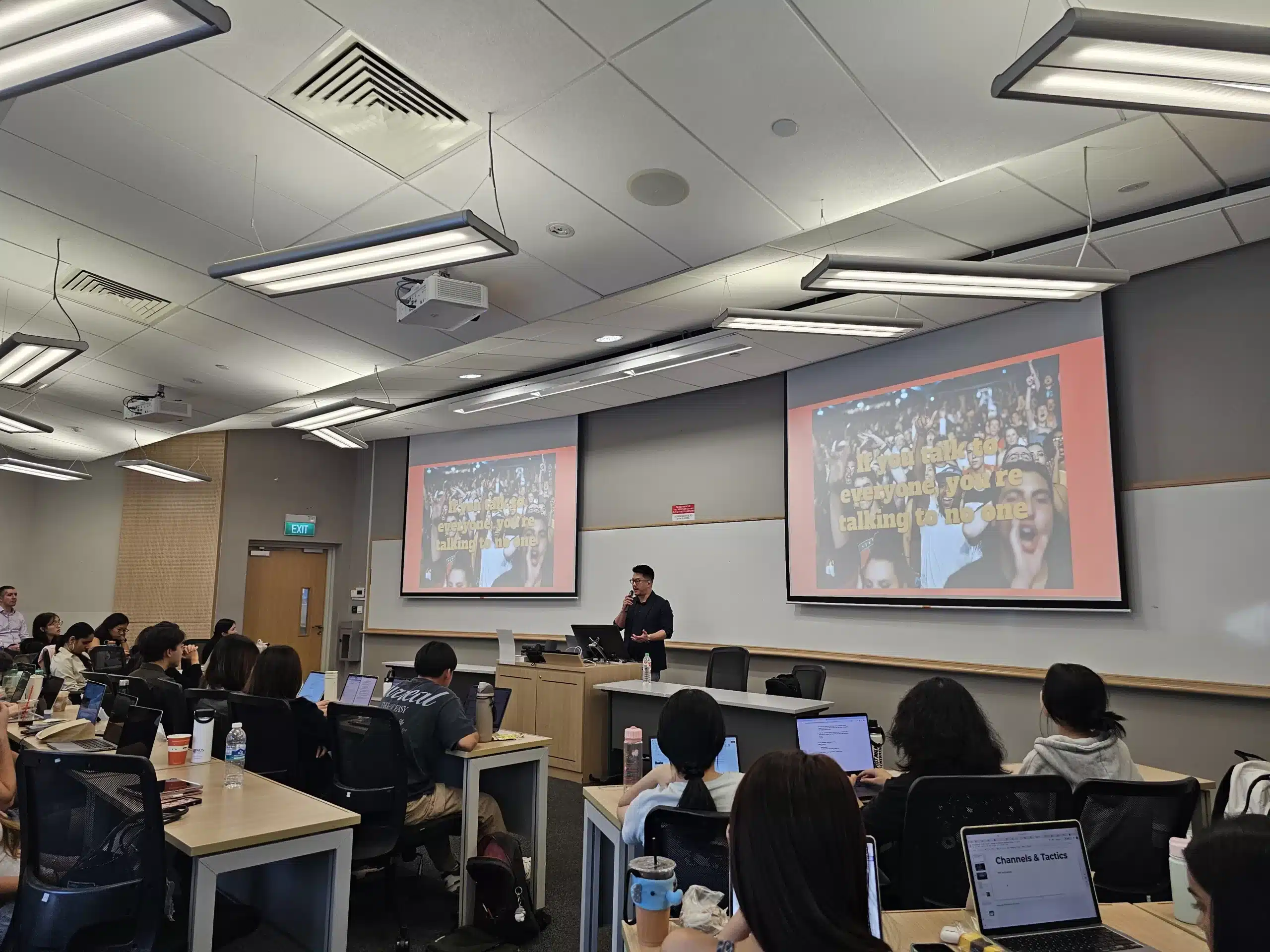

Last week I gave a guest lecture to about fifty marketing undergraduates at the National University of Singapore. Standing in front of students just beginning their careers took me back to my own start – except I never studied marketing in school. I learned it by doing: launching campaigns with shoestring budgets, experimenting with untested channels, and learning from people who knew more than I did. Those lessons compounded over time through curiosity, observation, and plenty of trial and error.
What struck me during the lecture is how much a marketing career still follows that same pattern. You’re always learning, adjusting, and adapting as you go.
Theory Meets Reality
The topic was “Choosing Marketing Channels and Tactics.” Simple in theory, messy in practice. Choosing the right mix isn’t about following a playbook, it’s about understanding your audience, clarifying your objectives, and making hard trade-offs with limited time and resources. A tactic that dominates in one market can die quietly in another. What looks brilliant in a deck doesn’t always survive contact with actual customers.
I structured the lecture around three principles that have consistently guided my work:
Adapt to local market needs. Every market is different. What resonates in Australia might fall flat in Japan. Across APAC, localization isn’t a buzzword – it’s survival.
Fail fast. The sunk cost fallacy kills campaigns. Learning to stop, extract the lesson, and pivot quickly is one of the most valuable skills you can develop.
You can’t do everything everywhere all at once. Focus wins. Prioritize the channels and tactics that actually drive results instead of diluting your impact across too many fronts.

What Actually Connected
To illustrate these principles, I shared real examples from my own campaigns: the wins and the embarrassing failures. This connected and showed how important stories are to getting your message across. The students asked great questions, they wanted to know how decisions were actually made under pressure, what went wrong, and what I’d do differently knowing what I know now.
It reminded me how powerful stories are for making sense of complexity. Stories give structure to the chaos of real projects. They show what principles look like when applied under constraints, with incomplete information, and with real consequences. Even when you’re discussing data or tactics, stories make the information stick because they reveal the human side, the pressure, the uncertainty, the learning.
Beyond the Classroom
This applies far beyond teaching. In marketing itself, the campaigns that cut through are built around clear, human stories. Behind every effective message is a narrative: a problem worth solving, a change that needs explaining, a better way forward. Tools and metrics matter, but they’re scaffolding around the story, not the story itself.
Great marketing doesn’t start with channels or tactics. It starts with understanding the story you’re trying to tell and who needs to hear it. Everything else flows from there.
Looking Forward
Leaving that classroom, I felt genuinely optimistic about the next generation. These students were engaged, skeptical in the right ways, and hungry to understand how the industry actually operates. If they hold onto that curiosity and keep building their own stories through experience, they’ll be more than ready for whatever marketing becomes next.
The fundamentals don’t change: understand your audience, tell a clear story, adapt when reality pushes back, and never stop learning. Everything else is just choosing which tools to use.